
What to Expect on Your First Visit
The first visit is designed to give you clarity. The goal is to understand what is going on, make meaningful corrections when appropriate, and determine early whether this approach is a good fit for you.
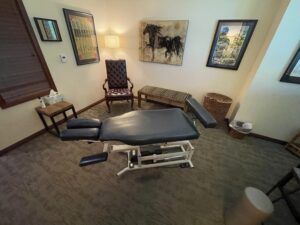
Step 1: Scheduling Your Appointment
Scheduling is straightforward. You can call, text, or book online. Paperwork is minimal and can be completed in advance if you prefer.
Visit length:
Your initial visit is scheduled for approximately 40 minutes. This allows time for a thorough assessment and initial treatment when appropriate.
Step 2: Evaluation and Assessment
Your visit begins with a review of your health history and a focused discussion of your current concerns, past injuries, and anything that feels unresolved.
Assessment is hands-on and movement-based. Rather than relying on routine imaging, I evaluate how your body is responding in real time to identify areas of strain, compensation, or instability.
X-rays or MRIs are not routinely required. Imaging is only recommended if there is concern for fracture, serious pathology, or a condition that requires further evaluation. If imaging is needed, you will be referred out.
There are no treatment contracts, prepaid plans, or assumptions made before seeing how your body responds.
Step 3: The First Adjustment
If treatment is appropriate, the first visit usually includes your initial adjustments.
Care is gentle and precise. Adjustments are performed in neutral positions without cracking, twisting, or end-range joint manipulation. The focus is accuracy, not force.
The first visit often addresses foundational regions such as:
-
Pelvis and lower back
-
Transitional spinal areas
-
Upper back and neck
-
Jaw and cranial structures when indicated
-
Extremities if they are clearly contributing
Many people notice meaningful change after the first visit. Others notice improvement after the second visit as the body continues to settle.
How This Approach Works
This method follows a structured, step-by-step process.
Rather than adjusting everything at once, primary areas are corrected first. Those changes often reveal deeper or previously hidden patterns that can then be addressed. This continues until the region stabilizes.
Because adjustments are precise and performed without force, the body is less likely to guard or become inflamed afterward. This is one reason changes tend to hold longer and why fewer visits are often needed.
Step 4: Follow-Up and Ongoing Care
Follow-up recommendations are based entirely on how well your body holds the initial corrections.
A common pattern is:
-
A second visit about one to two weeks after the first
-
A third visit, followed by maintenance care, several weeks later if needed
Some people need only one or two visits. Others benefit from additional care depending on history, injuries, and physical demands. There is no preset schedule.
If progress is not clear after the first few visits, we reassess and discuss next steps.
After Your Visit
Most patients experience little to no soreness. If soreness does occur, it is usually mild and short-lived.
As the body adapts, people often notice:
-
Improved movement and posture
-
Reduced pain or tension
-
Greater sense of stability
-
Easier recovery from daily activity
📲 Book your appointment today!
👉 Schedule Your Free Consultation Now
First Visit FAQs
Do I need to bring anything to my first visit?
No special items are required. Wear comfortable clothing and bring any relevant imaging or reports if you already have them.
Do you take X-rays on the first visit?
No. X-rays are not routine. Imaging is only recommended if there is concern for fracture, serious pathology, or a condition that requires further evaluation.
Will I be adjusted on the first visit?
In most cases, yes. If treatment is appropriate, adjustments are typically performed during the first visit. If not, we discuss why and what the next step should be.
Will my neck or back be cracked?
No. Adjustments are gentle and performed without forceful cracking, twisting, or end-range joint manipulation.
How will I feel after the first visit?
Many people feel lighter, looser, or more stable. Mild soreness is possible but uncommon and usually short-lived.
How will I know if this approach is working?
Most people can tell after the first visit whether this approach feels helpful. If progress is not clear, we reassess early.
Do I need to commit to ongoing care?
No. There are no contracts or prepaid plans. Care continues only if there is clear benefit.